Savoir & Connaître: How to Say You Know Something in French


There are so many things about French that make it both a beautiful and a difficult language. No matter how many languages you speak, there will always be a bit of a learning curve when it comes to adding another, and French is no different.
One important part of learning a language is sounding fluent. This involves studying and pronunciation practice, but it also means understanding linguistic concepts that you may not already be familiar with. In today’s case, we’re talking about how to correctly say you know something.
If you already speak another language, then you may be aware that some languages have more than one way of conveying something. Unlike English, many other Indo-European languages have more than one verb to express the concept of knowing. If you only speak English, this may be a harder concept to grasp at first, but don’t worry: By the end of this article, you’ll be well on your way to mastering it!
Key Take-Aways & Summary
There are two ways to say that you know something in French. These verbs are savoir and connaître. While at first you may not understand the difference between the two, it’s important to study them and know how to correctly use each verb. If you use the wrong one, the meaning of your sentence will change and people may not properly understand you.

What Is the Difference Between Savoir and Connaître?
For language learners who have already learned Spanish or have a background in the language, you’ll be happy to know that the French savoir and connaître function in the same ways as the Spanish saber and conocer. Even if you don’t confidently or fluently speak Spanish, having a basic understanding of saber and conocer will help you as you learn French. If French is the first foreign language that you’ve ever studied, it’s okay. This article will help you get started. So, let's get started!
Both savoir and connaître mean “to know”, but you can't use them interchangeably. Why not?
It was mentioned above briefly, but savoir and connaître have slightly different connotations. This means that using one over the other will change someone's understanding of the sentence. In some sentences, it isn’t the end of the world if you use one verb instead of the other. It will, however, make the meaning different and whoever you’re speaking with may either be a little confused or think that you’re saying something else.
So, without further ado, what exactly do these two words mean and what is the difference between them?

The Meaning of Savoir
In French, savoir is the verb you use to say you know: 1, something as a fact or a piece knowledge; or 2, how to do something.
In the first instance, savoir is conjugated according to the subject and usually followed by the word que and a sentence that can stand on its own. Here are two examples of what this may look like:
- I know that she has a cat > Je sais qu’elle a un chat.
- He knows when she wakes up > Il sait quand elle se réveille.
In both examples, savoir is used to indicate that the subject (je or il) has knowledge of something. This knowledge is almost always a fact or an action and will be in a following independent clause (the part that comes after que or quand).
In the second use of savoir, there will not be an independent clause. Instead, the second verb will remain as an infinitive and come directly after savoir. If it is a negative sentence and you’re trying to say you do not know how to do something, then the second verb (as an infinitive) will come after pas. Here are two examples:
- We know how to eat > Nous savons manger.
- They don’t know how to sing > Ils ne savent pas chanter.
Despite this use of savoir indicating the knowledge of how to do something, there is no inclusion of the word “how”. It is unnecessary in French.
Savoir is also used to say you know a language. As a French language learner, it is likely that you’ll have at least one conversation where you talk about which languages you know. These sentences will look a little different than in English. Take a look:
- I know French > Je sais parler le français.
In French, you can’t simply say that you know French (Je sais le français). Because savoir requires an infinitive verb, you must always add the verb parler (to speak) when talking about languages that you know.
The Meaning of Connaître
Connaître is used with a direct object, usually a person, place or thing. It means that you are personally familiar with that person/thing or have been somewhere. If you simply want to say that you know of somewhere (but you have never been there yourself), you would use savoir.
Connâitre isn’t too difficult once you understand it, but it can be confusing when you first start learning French. A good way to understand it is to think of it as meaning “to be familiar with” rather than “to know”. Connaître will never be used with factual knowledge or an action that you know how to do; that will only ever be savoir.
Don’t worry too much about trying to understand connaître perfectly. It will take time to understand the nuances and as you expose yourself to more French, you’ll start to make sense of it. For now, here are a few example sentences with connaître:
- I know a good restaurant > Je connais un bon restaurant. (I’ve been there personally)
- We don’t know Paris > Nous ne connaissons pas Paris. (We’ve never been there)
- She knows Emmanuel Macron > Elle connaît Emmanuel Macron. (She knows him personally)

How to Conjugate Savoir and Connaître
In order to correctly use savoir and connaître, you’ll need to know how to conjugate them.
Savoir has irregular conjugation, so make sure that you’re aware of this as you learn different French verb tenses as it won’t like to play nicely by the rules. Today, we’ll only take a look at the present conjugation.
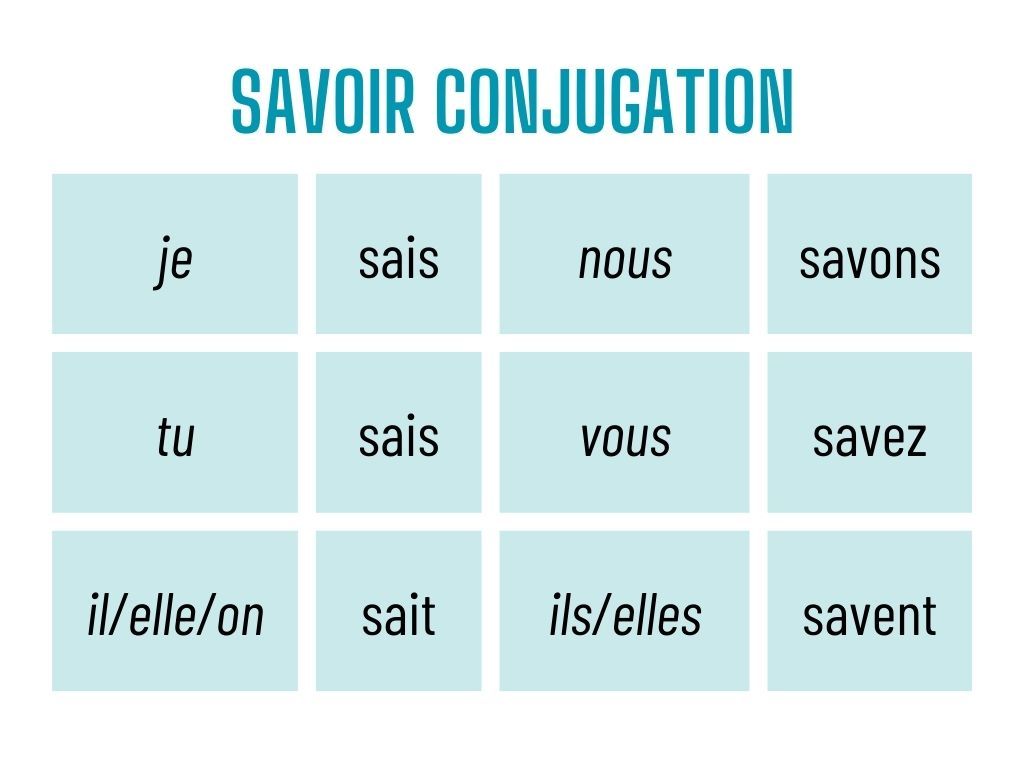
Now let’s take a look at the conjugation for connaître. It also follows irregular conjugation.
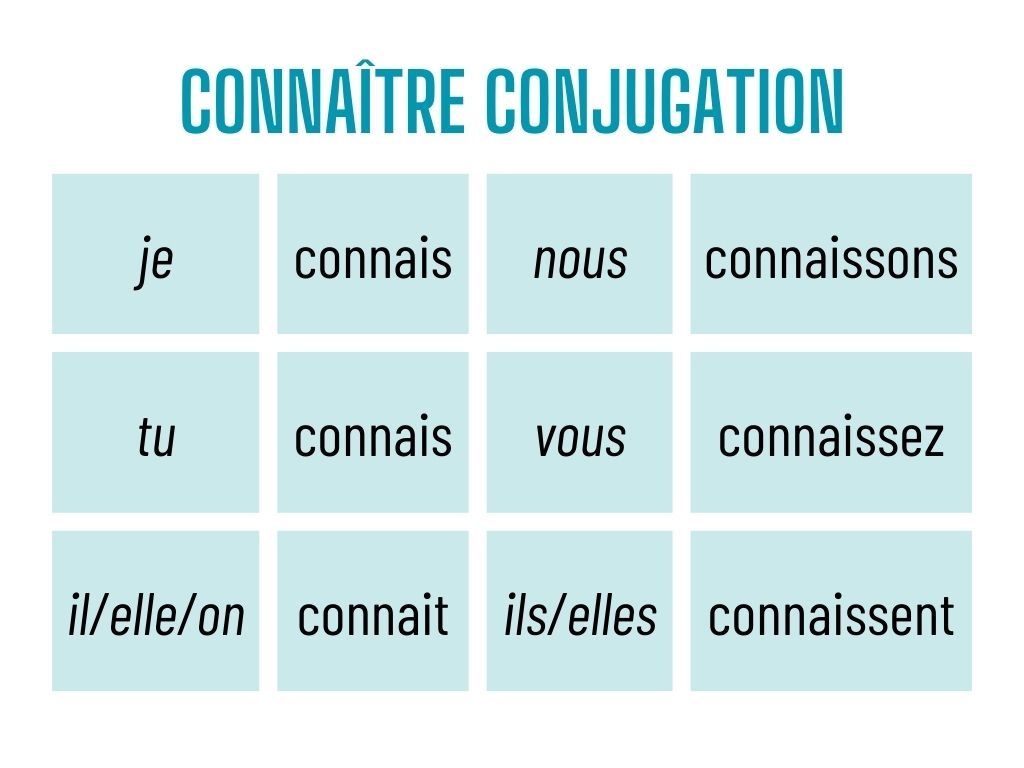
As you can see, the conjugation isn’t too difficult. If you’ve mastered French present tense conjugation, then these conjugations shouldn’t be that hard to remember. They follow the basic conjugation logic in French, and if you add them to your study session, you’ll be confidently conjugating both verbs in no time.
To help solidify this new knowledge, both of the conjugations and the correct meaning of savoir and connaître, here is a worksheet to help you practice with answers at the bottom.

7 Common Expressions Using Savoir or Connaître
There’s a lot to remember when you learn new grammar concepts and it can be hard to keep track of it all. Over time, the meanings of savoir and connaître will become clearer, but for now, here are seven common expressions that you’ll hear regularly and will want to know.
- Qui sait? > Who knows?
- Bien savoir > To know well
- Sans le savoir > Without knowing it
- On ne sait jamais > You never know
- Connaître par cœur > To know by heart
- Connaître ses limites > To know one’s limits
- Connaître la chanson > To have heard it all before
Don’t Be Afraid to Make Mistakes
Learning French takes time and practice and you’ll make mistakes along the way. Rather than getting frustrated with yourself, try to think of mistakes as a necessary step to improving your French fluency. We all start somewhere and getting annoyed for making mistakes isn’t beneficial to anyone. Instead, go easy on yourself and take the time to immerse yourself in any way possible, whether that’s through an immersion trip abroad or listening to a podcast at home.