How to Use the French Conditional and Si Clauses: A Complete Guide to Hypotheses


When you start your language learning journey, you most likely focus on learning a lot of vocab and the present tense of verbs. After that, you may go on to learn the past and future tense, but in French, the verb tenses don’t stop there. While past, present, and future tenses will make up a lot of your conversations and will definitely help you be understood, they aren’t the only tenses that you’ll encounter in French. One tense that you’ll encounter somewhat regularly is the conditional tense (le conditionnel).
Key Takeaways
This article will be a bit of a double grammar lesson, but don’t let that freak you out. The conditional tense isn’t too complicated and if you’ve come this far in your French learning journey, you’ll make it through to the end of this article just fine. However, if you want some extra advice before diving in, check out these 10 tips for French tenses and conjugation.

What is the French Conditional Tense?
If you’re going to learn a new verb tense, it’s important to first understand what its purpose is and what it does to the meaning of words when used. While the French conditional tense isn’t hard to use or know, it can be a bit confusing at first as it has a lot of different uses. First, let’s list them out.
The French conditional tense is used to:
- Form a polite demand or request > “Would you close the door?”
- Give advice > “You should try a croissant.”
- Express wishful thinking > “He would love to visit France.”
- Express something that is uncertain or only a rumor > “Emmanuel Macron may be a vampire.”
- Complete the phrase “au cas où”
- Express a hypothesis > “If I won the lottery, I would buy a car.”
As you can see, there are a lot of different uses for the conditional tense compared to the past, present, or future tenses. While it can seem a bit overwhelming, the more you expose yourself to the French language, the sooner you’ll start to feel confident in your use of each tense.

Conjugating the French Conditional Tense
If you’ve already learned French past tenses, especially the imparfait, then you already know the hardest part of conjugating the conditional tense. If you haven’t learned the various French past tenses yet, I suggest reviewing at least the passé composé and the imparfait before taking on the conditional as they will be necessary in the next part of this lesson.
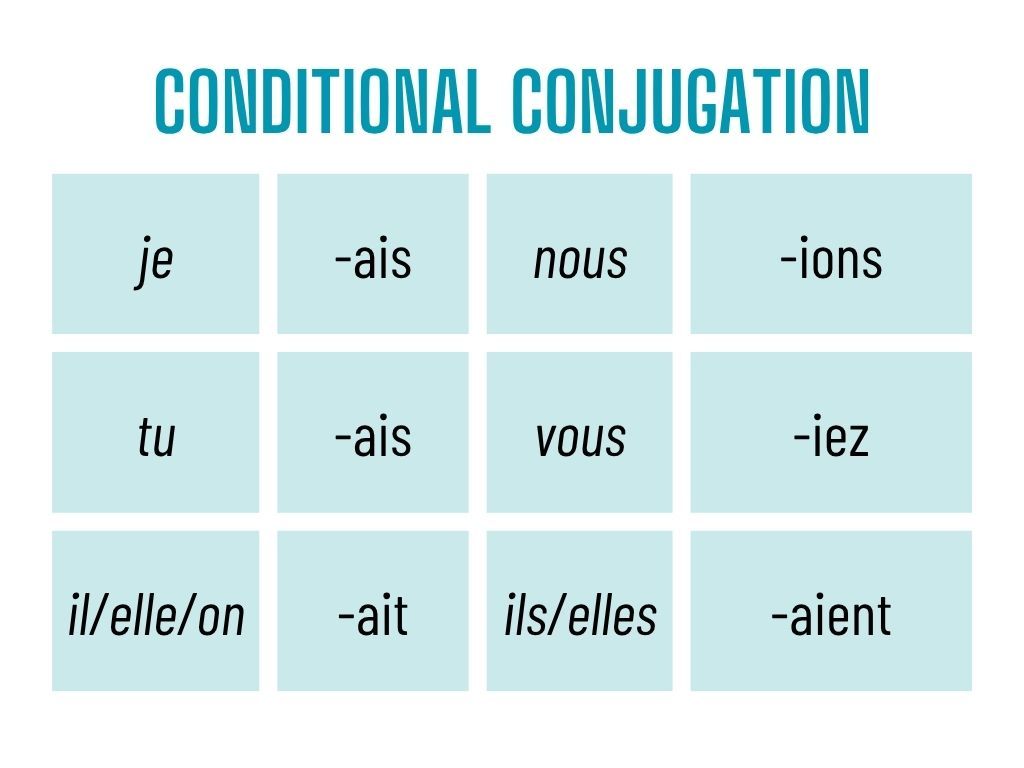
In most cases – barring irregular verbs and verbs that end in -re – the conditional tense is formed by taking the infinitive form of the verb and adding the imparfait ending that matches the subject. For verbs that end in -re, simply remove the “e” from the infinitive and do the same: Add the imparfait ending that matches the subject. Here are some examples:
- manger > (je) mangerais
- finir > (il/elle/on) finirait
- prendre > (nous) prendrions
When it comes to irregular verbs, the endings will remain the same (the corresponding imparfait ending). However, verbs that are irregular in the conditional tense will not use the infinitive to form the verb. Instead, they take on a different stem that the imparfait ending is then attached to.
Here is the list of irregular verbs in the conditional and their stems:
- aller > ir-
- avoir > aur-
- faire > fer-
- être > ser-
- pouvoir > pourr-
- vouloir > voudr-
- devoir > devr-
- savoir > saur-
- venir > viendr-
- voir > verr-
Similarly, any verbs that have a version of these irregular verbs in their own stem (such as devenir, satisfaire, and verbs ending in -ouvoir) will change. All endings will remain the same.
Forming the past conditional (le conditionnel passé) is very similar to forming the passé composé. Take avoir or être, whichever one the verb would usually take, put it in the correct form of the conditional, and then add the past participle of the verb. Here are the same examples from above but in the past conditional:
- manger > (j’)aurais mangé
- finir > (il/elle/on) aurait fini
- prendre > (nous) aurions pris
I know it’s a lot all at once, but the conditional won’t take too long to understand once you get the gist of it. Reading and listening to French will help speed things along, but don’t feel bad if the conjugation feels clunky. If you want to practice it right away and test yourself to see how much you’ve retained so far, try this little quiz.
How to Express Hypotheses
Now that you know how to conjugate the French conditional tense, it’s time to learn one of the biggest and most common uses of this tense: Expressing hypotheses or if-then scenarios.
As you saw before, the conditional is used in a lot of situations. When you’re first learning it, however, it can be a good idea to limit it to its most common use. In this case, that means hypotheticals.
To express a hypothetical in French, you need to already know the French present, passé composé, imparfait, and the future. Knowing the impératif can also be beneficial, but it isn’t a necessity in order to form hypothetical or conditional if-then sentences.
Depending on the level of certainty in your hypothesis or if-then sentence, you will use a different tense. In all cases, you will need to use the word si. In the case of forming a hypothetical, si is equivalent to “if”. It has other meanings, but you don’t need to worry about confusing them when making a hypothetical. Everyone will understand what you mean.
For a hypothesis that is almost certain, you will use either the present or the passé composé followed by the present or the simple future. The conditional tense is not necessary in these situations and using it reduces the likelihood of the hypothesis. Here is an example as well as the formula to follow when forming hypotheses that are almost certain:
- If I eat chocolate, (then) I will be sick > Si je mange du chocolat, je tomberai malade
- Si + present or passé composé + a comma + the present or the simple future
In French hypotheses, there is no equivalent for the word “then”. While in English you can choose to include “then” or not, you don’t have the option in French. If it helps, you can think of the comma as the French equivalent to the English word “then” in these types of sentences.
When forming a hypothesis that is unlikely, you use first the imparfait and then the conditional. Here are the examples:
- If I won the lottery, I would buy a car > Si je gagnais le loto, j'achèterais une voiture
- Si + imparfait + a comma + the conditional tense
While less common, you may find yourself wanting to form a hypothesis that is impossible or entirely in the past. In most cases, an impossible hypothesis is something where both the “if” sentence and the “then” sentence need to have happened in the past. Since they haven’t happened, you know the hypothesis is impossible. To form this type of hypothesis, you use first the plus-que-parfait past tense and then the conditional past:
- If I had won the lottery, I would have bought a car > Si j’aurais gagné le loto, j’aurais acheté une voiture
- Si + plus-que-parfait + a comma + the conditional past
The most important thing to remember is that the clause after si is the thing that must happen in order for the second clause (the “then” clause) to come true. The order of the sentences can be reversed, but it’s important to keep si with the correct clause and verb tense. Here are the same examples from above but with the sentences reversed:
- I will be sick if I eat chocolate > Je tomberai malade si je mange du chocolat
- I would buy a car if I won the lottery > J'achèterais une voiture si je gagnais le loto
- I would have bought a car if I had won the lottery > J’aurais acheté une voiture si j’aurais gagné le loto
As you can see, the verb tenses remain the same in each clause; only the order has been changed. Just like how the sentence maintains its meaning in English when we reverse the order, it’s possible to do it in French. The only thing to be sure and remember is to keep si with the right clause and ensure the verb tenses remain correct for what you’re trying to say.

Have Fun With It
A lot was covered in this article so it’s okay if you feel a little overwhelmed. Don’t let that stop you from practicing this new verb tense and sentence structure.
While you practice, be sure to have fun with it as that will increase the chances of you remembering what you’ve studied. Use memorable French hand gestures or come up with funny stories. You won’t speak in monotone sentences anyway, so practice having fun and goofing off in your target language. After all, not only is that a great way to improve memorization, but it’s also a good way to stay motivated while learning.